Annual Report
Coral Reef Targeted Research &
Capacity Building for Management Program

Acknowledgements
This report was developed and collated by Melanie King (Executive Officer, Project Executing Agency) with
significant contributions from the following Program members:
Professor Ove Hoegh-Guldberg, Chair Bleaching Working Group
Professor Peter Sale, Chair Connectivity Working Group
Professor Drew Harvell, Chair Disease Working Group
Professor Peter Mumby, Chair Remote Sensing Working Group
Dr Alasdair Edwards, Chair Restoration & Remediation Working Group
Professor Roger Bradbury, Chair Modelling & Decision Support Working Group
Professor Ed Gomez, Chair Southeast Asian Centre of Excellence
Dr Roberto Iglesias-Prieto, Chair Mesoamerican Centre of Excellence
Professor Alfonse Dubi, Chair East African Centre of Excellence
Dr Christopher Muhando East African Centre of Excellence
Mr Andy Hooten, Synthesis Panel Executive Secretary & US Coordinator
Mr Mark Paterson, Communication Coordinator Currie Communications
Mrs Kristen Sampson, Finance Officer Project Executing Agency
Contributions have also been received from Working Group members through their individual reports.
Further Information
Information used in this report has been collated from the individual Working Group and Centres of Excellence
2008 Annual Reports and from communication activities during the reporting period. Additional information has
been produced with the input of the Management Team.
For further information regarding this report and/or to request copies of individual Working Group and Centre of
Excellence reports, contact the Executive Officer, Melanie King at m.king4@uq.edu.au.
Coral Reef Targeted Research & Capacity Building for Management Program, c/- Centre for Marine Studies,
Gerhmann Building, The University of Queensland, St Lucia, Queensland 4072, Australia
Tel: +61 7 3346 9942 Fax: +61 7 3346 9987 Email: info@gefcoral.org Internet: www.gefcoral.org
Published November 2008
2


2008 Annual Report
1
Contents
- Acknowledgements
2
- Executive Summary
5
Component 1
7
Addressing Knowledge and Technology Gaps
8
- Coral Bleaching and Local Ecological Effects
9
2
- Coral Reef Connectivity and Large-Scale Ecological Processes
10
- Coral Disease
12
- Modelling and Decision Support
14
- Remote Sensing
16
- Coral Restoration and Remediation
18
- Students
21
Component 2
25
Promoting Scientific Learning and Capacity Building
26
- Australasian Centre of Excellence
27
3
- East African Centre of Excellence
28
- Mesoamerican Centre of Excellence
28
- Southeast Asian Centre of Excellence
31
Component 3
33
Linking Scientific Knowledge to Management and Policy
34
Component 4
37
Program Management
38
4
Abbreviations
42
3

4
2008 Annual Report
Executive Summary
The Coral Reef Targeted Research & Capacity Building for Management (CRTR) Program is seeking:
· To fill the critical gaps in our global understanding of what determines coral reef ecosystem vulnerability and
resilience to a range of key stressors from localized human stress to climate change; and
· To inform policies and management interventions on behalf of the coral reefs and the communities which
depend upon them.
Nearing the completion of Year Four in the first five-year phase of the CRTR Program, much of the research is
now culminating in the synthesis and release of results. This Annual Report covers the period 1 April 2008 to 30
September 2008.
As the Program moves into the final year of the Phase during 2009, many of the scientific Working Groups and the
Centres of Excellence will begin consolidating their findings and information and producing information `products'
for audiences, including scientists, coastal and coral reef managers and agencies, and policy-makers.
The past year has seen the emergence of research findings, including:
· A model detailing biology, behaviour and geographic patterns of spawning potential for the Caribbean
Spiny Lobster, Panulirus argus. It is expected that patterns of lobster connectivity for the Mesoamerican
region will be able to be produced.
· Preliminary data into the effects of aquaculture effluent on coral health and disease is showing that poor
water quality may compromise aspects of immunity.
· Research into investigations as to whether coral disease patterns are influenced by the establishment of
MPAs is supporting the hypothesis that when a fish community is protected from over-harvesting, it will
create healthier conditions in the reef community and lower coral disease prevalence. Information from this
research will have important impacts on MPA planning and design in the future.
· Regional scale models for the Mesoamerican and Philippine regions which test scenarios of human and
biophysical drivers in the system, continue to be `fine-tuned'. When completed, these models will be useful
for management and policy work, particularly when they are coupled with the appropriate socio-economic
models under development.
· The creation of decision-support and analysis software for monitoring the health of coral reefs using remote
sensing is wel on its way towards completion. These models wil be useful for students and scientists from
developing countries who cannot afford the commercially-available solutions.
The Program's four regional Centres of Excellence continue to cement their place as a `hub' for research and training
opportunities in their regions, with research results from local projects now being used to influence government
decisions on coastal development, as demonstrated this year with the Mesoamerican Centre of Excellence.
"Research results from local projects (are) now being used
to influence decisions on coastal development."
Complementing the work under the Working
Groups and Centres of Excel ence has been
their support of student scholarships. Fol owing
the enormous success of last year's Future
Leaders Forum which brought together al of
the CRTR-supported students, the student
network now extends to approximately 60
students from 17 countries. While these young
scientists are contributing to the work of the
Working Groups and Centres of Excellence,
they are also building and expanding on their
linkages with each other. Fol owing a meeting
at the ICRS in July, the student group has
formed its own communication committee
and is working on joint journal articles and
products.
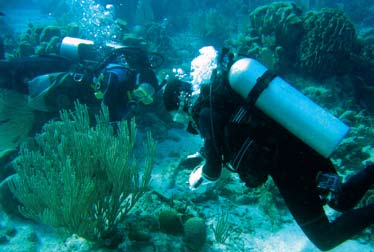
Researcher Dr Bob Steneck (l) and PhD student Susie Arnold working on a
settlement plate at Glovers Reef, Belize
5
In addition to the research element, the
Program has continued to make strong
in-roads into building the capacity of
scientists and managers in developing
countries through student scholarships,
training workshops and courses, and the
release of new information. During 2008
the Program undertook or participated in
69 events training courses, workshops,
media opportunities, meetings and
conferences. In addition to this, Program
members produced 174 publications,
comprising
journal
articles,
book
chapters, conference papers, media
articles or electronic products. These
publications are classified as either fully or
partially supported by the Program, or not
supported but having an influence on, or
being influenced by, the research being
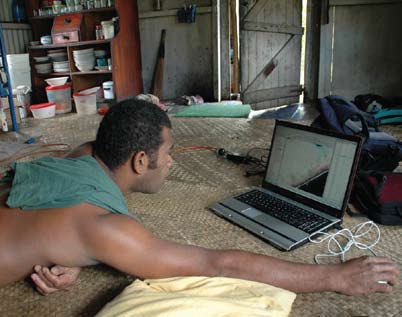
Local community representative is validating satel ite image of coral reef, Vitu Levu, undertaken by the Program Working
Fiji. Photo: Chris Roelfsema
Groups and Centres of Excellence.
Information products continue to be deveoped and disseminated through various channels. In July, the ICRS
saw the release of the Coral Disease Handbook: Guidelines for Assessment, Monitoring and Management, and
Underwater Cards for Assessing Coral Health for Indo-Pacific and Western Atlantic Reefs. These products
are aimed at assisting managers and researchers to recognise the signs of coral disease and how to measure
the impact and monitor the outbreaks. These products are available through the CRTR Program's website at
www.gefcoral.org.
In addition to the Handbook and Underwater Cards, the Restoration Guidelines have now been produced
in three languages English, French and Bahasa Indonesia and available through the website. A Spanish
translation is underway and will be available during 2009. Further publications include updated Research
Updates and Advisory Papers.
The fifth and final year of Phase One will see a culmination of synthesised research information, information outputs
and capacity building activities being undertaken, together with a major planning effort as the Program develops
its plans for Phase Two.
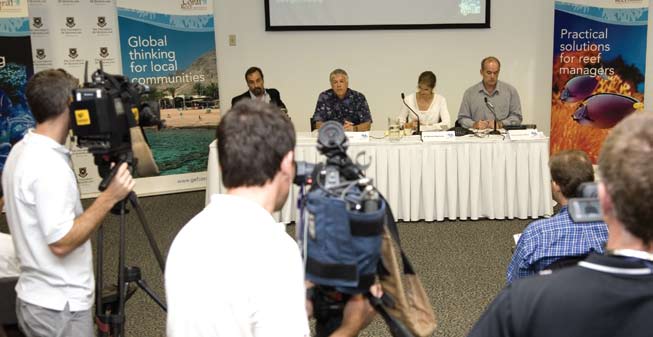
Members of the Synthesis Panel give a press conference. L to R - Prof Roberto Iglesias-Prieto (Universidad Nacional Autonoma de Mexico,
Dr Peter Sale (United Nations University), Dr Marea E. Hatziolos (World Bank), Prof Ove Hoegh-Guldberg (Centre for Marine Studies,
The University of Queensland).
6
2008 Annual Report
1
17 The number of countries where students
sponsored by the CRTR Program are from
Addressing Knowledge
and Technology Gaps
1
Component
7
Addressing Knowledge
and Technology Gaps
During the past 10 years, more people have become aware of the importance of coral reefs, especially in light
of their rapid decline in many regions and their significance to developing countries. However, what remains
fundamentally unknown about these ecosystems is alarming, especially when management interventions are
becoming increasingly important.
Significant gaps in understanding coral reefs remain. The CRTR Program's six scientific Working Groups, consisting
of interdisciplinary teams of scientists from developing and developed countries, are addressing these issues
through targeted research across the following themes:
· Coral bleaching and local ecological processes
· Coral reef connectivity and large scale ecological processes
· Coral disease
· Modelling and decision support
· Coral restoration and remediation
· Remote sensing
The CRTR Program is undertaking research across these themes in various locations around the world. Each
Working Group is operating within the locations of the regional Centres of Excel ence (Australia, Tanzania, Mexico
and the Philippines), as wel as other locations including Palau, Belize, the Red Sea, and various other locations to
extrapolate research results and link them into information for coral reef and coastal managers, policy-makers and
decision-makers. The progress in the past year for each of these themes is outlined in this report.
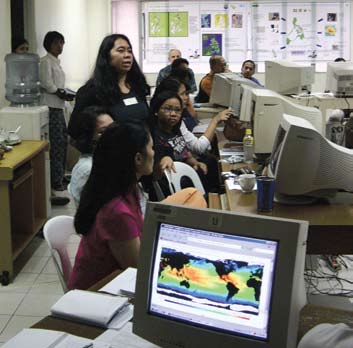
Participants of a Capacity Building Workshop learn to use remote sensing
as a decision support tool. Photo: Robert Canto
8


2008 Annual Report
Coral Bleaching and
1
Local Ecological Effects
Working Group Members:
Prof Ove Hoegh-Guldberg, Chair Centre for Marine Studies, The University of Queensland, Australia
Prof Yossi Loya, Co-Chair Department of Zoology, Tel Aviv University, Israel
Prof Robert van Woesik Department of Biological Sciences, Florida Institute of Technology, USA
Dr Tim McClanahan The Wildlife Conservation Society, Kenya
Dr Roberto Iglesias-Prieto Instituto de Ciencias del Mar y Limnologia, Universidad Nacional Autonoma de Mexico
Dr Ruth Gates Hawaii Institute of Marine Biology, University of Hawaii, USA
Dr Michael Lesser Department of Zoology, University of New Hampshire, USA
Dr John Bythell Department of Marine Sciences & Coastal Management, University of Newcastle, UK
Dr David Obura CORDIO East Africa, Kenya
Dr Ron Johnstone Centre for Marine Studies, The University of Queensland, Australia
The fundamental science that has been produced by the Group continues to improve the understanding of the
impacts of global warming on coral reefs. A major highlight of the work from the Bleaching Working Group (BWG)
members during the past year has been the demonstration of the effect of thermal history on the susceptibility of
reef-building corals to heat stress; a more precise understanding of the photoprotection pathways in symbiotic
dinoflagellates and; the demonstration that the susceptibility and mortality of corals is determined by fine scale
differences in symbiotic types.
Work has continued on the geographical diversity of Symbiodinium project, with samples that were taken in 2008
filling many of the gaps in our knowledge about the geographical distribution of the all-important symbionts of reef
building corals, Symbiodinium. In addition, Group members have produced several papers which have contributed
to the understanding of host-symbiont mutualism, as well as the close associates and the accompanying responses
of corals to environmental change. The work by Dr Ruth Gates is showing there may be a link between the type of
Symbiodinium and the susceptibility of corals to disease. Papers in this area has emphasised the observation that
corals associate with many more organisms than simply dinoflagellates, and that these microbial partners may be
critical to our understanding of both the stability and the instability of corals to environmental change.
"The Working Group has produced a series of high-profile
papers on the impact of global warming and ocean acidification
on coral reefs."
Research continues on trying to understand the relationship of other coral reef organisms to coral communities,
with a series of 11 papers published that describe the `whole of community' changes that have been occurring in
the Western Indian Ocean. This effort is complementary to the long-term ecological studies that are now occurring
at all four Centres of Excellence, where three years of data has been gathered.
Under the `Understanding the mechanisms of coral bleaching' project undertaken by Dr Iglesias-Prieto, the
research is continuing to provide an in-depth understanding of how light interacts with thermal stress to cause
coral bleaching. Complementing this work, is the work undertaken by Dr Lesser exploring the molecular genetics
of oxidative stress and nitrogen fixation in corals, anemones and symbiotic dinoflagellates. The work will deliver
new insights into the mechanisms that lead to bleaching.
Using the insights gained through research efforts, the Working Group has produced a series of high-profile
papers on the impact of global warming and ocean acidification on coral reefs. The Group, like all CRTR Working
Groups and Centres of Excellence, was well-represented at the 11th International Coral Reef Symposium held
at Fort Lauderdale during July. The Group contributed over 40 abstracts to the Symposium with members also
playing a major role in the Symposium's organisation.
9
Coral Reef Connectivity and
Large-Scale Ecological Processes
Working Group Members:
Prof Peter Sale, Chair Biological Sciences, University of Windsor, Canada
Dr Carmen Ablan Molecular Genetics Laboratory, The WorldFish Center, Malaysia
Dr J Ernesto Arias Lab. Ecologica de Ecosistemas de Arrecifes Coralinos, CINVESTAV-U, Mexico
Prof Mark Butler IV Department of Biological Sciences, Old Dominion University, USA
Prof Robert Cowen Rosenstiel School of Marine and Atmospheric Science, University of Miami, USA
Dr Bret S. Danilowicz Paulson College of Science & Technology, Georgia Southern University, USA
Dr Geoff Jones School of Marine Biology & Aquaculture, James Cook University, Australia
Dr Serge Planes Centre National pour la Recehrche Scientifique, Universite de Perpignan, France
Prof Barry Ruddick Department of Oceanography, Dalhousie University, Canada
Dr Yvonne Sadovy Society for the Conservation of Reef Fish Aggregations, The University of Hong Kong
Prof Robert Steneck School of Marine Sciences/Darling Marine Center, University of Maine, USA
Prof Alina M. Szmant Coral Reef Research Group, Center for Marine Science, University of North Carolina at
Wilmington, USA
Dr Simon Thorrold Biology Department, Woods Hole Oceanographic Institution, USA
Dr Mary Alice Coffreth Department of Biological Sciences, State University of New York, USA
Dr Ken Lindeman Environmental Defense, Miami, USA
Dr Enric Sala Center for Marine Biodiversity and Conservation, Scripps Institute of Oceanography, USA
Year Four (2008) was the final period of direct research funding for the Connectivity Working Group, with the final
year in Phase One (2009) to be a period of focusing on analysis and publication of results. The Group aims to
concentrate efforts on the transfer of information to the management community and synthesising results. The
research activities under the Working Group have continued to progress with some of the most innovative work in
reef fish connectivity being undertaken in Papua New Guinea under Drs Geoff Jones, Simon Thorrold and Serge
Planes through complementary funding external to the CRTR Program.
Research activities funded by the Program are making good progress with the project `Connectivity in Bicolor
damselfish' evaluating the use of several approaches to measuring connectivity in fish species that do not aggregate
over large distances to spawn. Using the bicolor damselfish as the model species and undertaking fieldwork in
Mexico, Honduras and Belize, the research is combining genetic assignment tests, otolith microchemistry, ecology
of settlement patterns and data on hydrodynamics and habitat (collected during the ECONAR project), to develop
data on patterns of connectivity of populations of this common species in the Mesoamerican Caribbean. The project
will finalise the analysis in 2009, applying both otolith chemistry and genetic parental assignment approaches to
the same individual recruits to determine the congruence in answers concerning their natal sources.
880
870
3
200
2
Mexico
1
MBRR
0
Factor 2
TA
-1
BC
Belize
-2
160
Ba138
Mg25
Honduras
-3 -3 -2
-1
0
1
2
3
Factor 1
Figure 1 A plot showing the chemical differences among the three sub-regions (Barrier Reef, Turneffe Atol and Banco Chinchorro) within the
MBRS and a map putting these differences into a geographical context. Figures reproduced from JD Hogan Dissertation (2007).
10
2008 Annual Report
Regular censusing of coral recruitment and early survivorship under the `Settlement Bottlenecks' project has
now been completed with patterns of coral settlement and recruitment showing they are clearly dissociated by
1
factors such as a lack of grazing of algae at many sites. The research has found a surprising widespread inverse
relationship between algal biomass and the density of newly settled corals, their survivorship, juvenile coral
population density and their survivorship. This pattern shows no similar relationship with the population density
and/or species density of scleractinian corals. The strength of these local effects is so great, that they could mask
demographically relevant connectivity occurring from a distant source.
The `Coral Connectivity' project is taking a variety of approaches and applying them to studies of coral larval
biology and behaviour, genetic variation among coral populations, immunogenetic tools for recognition of coral
planulae, and magnetic bead techniques for fine-scale demonstrations of dispersal of particles that `behave'
like planulae. The project has been successful in refining the various tools and approaches but due to limited
funding, progress against a large-scale field experiment to demonstrate dispersal from a spawning event has
been limited.
The `Lobster dispersal and connectivity' project has been more successful as it studies the biology, behaviour and
geographic patterns of spawning potential of the Caribbean Spiny Lobster, Panulirus argus. The research team
is using existing or new finer-resolution hydrodynamic models with recruitment data providing a way to validate
model output. The project is now primarily in a model-building phase, although the effort to monitor recruitment
will continue until early 2009. It is expected that the project will be able to generate an expected pattern of lobster
connectivity for the Mesoamerican region.
In addition to building the research effort, the Working Group
has continued to support students and undertake training
workshops. The Group completed a successful joint workshop
with The Nature Conservancy (TNC) and the network of
Mesoamerican managers in Fort Lauderdale in July, following
the ICRS. In addition to this, the results of the October 2007
Townsvil e workshop with the Australian Research Council's
Centre of Excellence for Coral Reef Studies has been
packaged as six review papers on aspects of connectivity and
management which will be submitted to Coral Reefs for
review and publication in late 2009.
The annual workshops with management agency and NGO
personnel in the Mesoamerican region continue to be
successful with more senior managers now attending as the
focus shifts towards how to use connectivity and recruitment
data in guiding management of protected areas. The
preparation of reports in accessible formats is a high priority
and the Group wil continue to work with TNC in facilitating
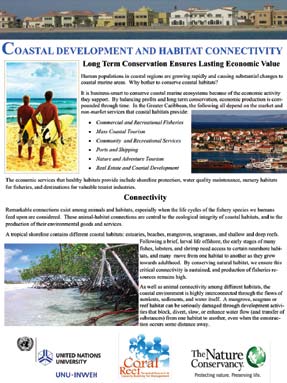
communication. Already a flyer has been produced in
English and Spanish - `Coastal Development and Habitat
Connectivity' - which looks at the connectivity implications
of coastal development is available for download from the
UNU-INWEH website at www.inweh.unu.edu.
Front page of `Coastal Development and Habitat
Connectivity' brochure.
11

Coral Disease
Working Group Members:
Prof C. Drew Harvell, Chair Section of Ecology and Evolutionary Biology, Cornell University, USA
Prof Bette Willis, Co-Chair School of Marine Biology and Aquaculture, James Cook University, Australia
Dr Garriet Smith, Co-Chair Department of Biology and Geology, University of South Carolina-Aiken, USA
Dr Eric Jordan Dahlgren Instituto de Ciencias del Mar y Limnologia, Universidad Nacional Autonoma de Mexico
Prof Farooq Azam Scripps Institution of Oceanography, University of Southern California, USA
Dr Laurie Raymundo Marine Laboratory, University of Guam, USA
Prof Eugene Rosenberg Department of Molecular Microbiology and Biotechnology, Faculty of Life Sciences,
Tel Aviv, Israel
Prof Ernesto Weil Department of Marine Sciences, Universidad de Puerto Rico Mayaguez, Puerto Rico
The annual coral disease surveys remain an important aspect of the Disease Working Group's (DWG) research
initiative as it provides valuable information on temporal and spatial changes in coral community structure and
disease syndromes/signs prevalence, and the long-term data gathered will facilitate informed management
decision-making for the maintenance of ecosystem health. During the past four years the Group has conducted
surveys at all CRTR Centres of Excellence as well as establishing comprehensive monitoring programs in locations
including the Caribbean, Western Atlantic and Guam.
Members of the DWG have also been instrumental in working on the issue of identifying links between water
quality and coral disease. Early results from this research indicate that poor water quality causes syndromes such as
Aspergillosis, Black Band, and Yellow Band to progress more quickly. Work in the Yucatan under Dr Eric Jordan is
also assessing the potential relationships between the relative digress of local development and several community
processes and structural characteristics, as well as on basic population parameters of selected species.
With the growing demand for aquaculture the DWG is also focusing on the effects of aquaculture effluent on
coral health and disease. Work being undertaken by Prof Farooq Azam and his team in Bolinao, Philippines
has confirmed the presence of strong nutrient and microbial gradients from the fish cages surrounding the reef.
Initial results are suggesting that algal blooms near the fish cages are persistent through at least two seasons,
whilst corals transplanted along a water quality gradient displayed the greatest response within the first few days
after transplantation particularly in poor water quality. Preliminary data is suggesting that poor water quality may
compromise some aspects of immunity.
Work is also continuing under the guidance of Dr Laurie Raymundo into investigations as to whether coral disease
patterns are influenced by the establishment of MPAs. Data from the 2006 and 2007 surveys is supporting the
hypothesis that when a fish community is protected from over-harvesting, it will create healthier conditions in the
reef community and lower coral disease prevalence. Further data analysis is being conducted to elucidate the
mechanisms of this relationship, but the presence of certain families of fish appears to be most closely related
with disease prevalence.
A high priority of the Working Group has been to identify which disease syndromes are caused by infectious
agents. In 2008, Prof Bette Willis and her group made significant progress with four papers on causative agents of
diseases in the Indo-Pacific (skeletal eroding band, brown band, white syndrome, and atramentous necrosis). In
the Caribbean, eight years of data on disease prevalence and average lesion growth rates (cm/month) of CYBD
showed significant correlations with average surface water temperatures in Puerto Rico. This year Working Group
members (Jordan, Weil and Smith) performed additional infectivity experiments with Caribbean Yellow Band
Disease (CYBD) in Puerto Morelos and in Puerto Rico, with particular focus on whether higher water temperature
facilitates transmissibility of disease. Data shows some effect of temperature when pathogens are directly
inoculated, but no transmissibility was observed in either of the experiments.
A number of training workshops have also been initiated with Australian-based workshops under Prof Bette Willis,
providing basic training in disease identification to marine biologists and dive operators working in the tourism industry
and to the AIMS Long Term Monitoring Team in order to improve their capacity to survey reef health annually. In the
Caribbean, Dr Ernesto Weil has conducted annual workshops to train students, NGOs, government personnel and
the general public how to identify coral diseases and continue the monitoring program after the final surveys in 2009.
These workshops have raised awareness about coral disease and have resulted in an expanding network of "eyes on
the reef", which will enable our working group to better document the occurrence of coral disease on reefs.
12
2008 Annual Report
Building on the collaborative project initiated in 2007 with the RSWG, members of the Disease Working Group have
refined the Disease Algorithm model exploring the links between thermal stress and disease abundance. The new
1
model highlights the complexity of the relationship between temperature and disease abundance. The existing
models will now be improved by increasing the resolution of the satellite data, including additional metrics, and
incorporating new coral health parameters. The model uses predicted sea temperature data and will therefore be
able to consider future scenarios and identify the potential efficacy of various management outcomes.
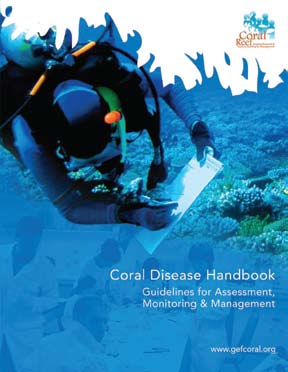
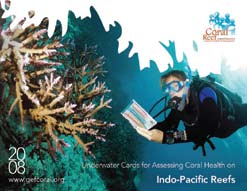
Coral Disease Handbook:
Guidelines for Assessment,
Monitoring and Management
One of the primary initiatives of the Working Group in 2008
was the production of the Handbook and Underwater Cards,
which are forming the basis of programs to educate managers
and professionals working in the reef tourism industry,
enabling them to gather information on coral disease and
contribute to a database on the abundance of disease and
occurrence of outbreaks on the Great Barrier Reef. The Cards
are also assisting to train managers to recognise signs of coral
disease throughout the Indo-Pacific and Western Atlantic,
thereby contributing to decision-making about appropriate
management actions.
The Handbook outlines procedures for describing signs,
measuring disease impacts, monitoring disease outbreaks,
assessing causes, and managing reefs to minimise losses due
to disease. The Handbook aims to integrate critical, current
scientific information about coral disease to support and
strengthen coral reef management.
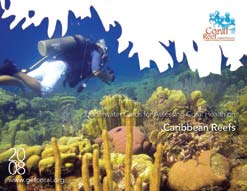
Underwater Cards for Assessing
Coral Health for Indo-Pacific and
Caribbean Reefs
The cards start with a decision tree for assessing the health status
of corals. The decision tree is colour coded to assist with navigation
through the cards. This step-by-step approach enables users to
assess the health status of a coral. Observations can be recorded
on a datasheet provided at the end of the card set. By using the
underwater identification cards, managers, researchers and other
interested parties can:
· Learn to identify coral diseases and survey techniques for
measuring coral disease prevalence;
· Gather information on the distribution and abundance of coral
diseases on local reefs;
· Monitor the health of local coral reefs and identify potential
drivers of disease abundance;
· Contribute to a world-wide database on coral disease; and
· Help to conserve the world's coral reefs.
Samples of these products can be viewed and/or orders placed
from the CRTR Program's website at www.gefcoral.org/publications.
Products are available for ordering at US$20 or AUD$24.20 each
from the website.
13

Modelling and Decision Support
Working Group Members:
Prof Roger Bradbury, Chair Research School of Pacific and Asian Studies, Australian National University, Australia
Dr Pascal Perez, Co-Chair Research School of Pacific and Asian Studies, Australian National University, Australia
Dr Porfirio Alino Marine Science Institute, University of the Philippines, Philippines
Dr Ernesto Arias Lab. Ecologia de Ecosistemas de Arrecifes Coralinos, CINVESTAV-U, Mexico
Dr Peter Campbell Advanced Computer Applications Center, Argonne National Laboratory, USA
Dr Bohdan Durnota Tjurunga Pty Ltd, Australia
Prof Rob Seymour University College London, UK
The Modelling and Decision Support Working Group (MDSWG) has maintained the momentum of the previous
year - in particular in the area of parameterisation of the various models through consistent cooperation within the
group, and collaborations with other Working Groups and Centres of Excellence. The MDSWG is developing a
set of novel, state-of-the-art models at the local, regional and global scales of the interaction between coral reef
ecosystems and the human societies that depend on them. These models will help users understand the complex
interactions between the biophysical processes in reefs and the socio-economic processes in their associated
human communities. They will also allow users to explore new and better ways to both sustain these ecosystems
and extract greater economic value from them. Thus the models are directed to the twin goals of the sustainability
of coral reef ecosystems and the alleviation of poverty in neighbouring communities.
For the fundamental ecological models, the Group now has a fully-validated fundamental mathematical
framework to underpin local and regional models that interact with each other. Group members have completed
the first attempt at deriving parameter ranges for Banco Chinchorro (Mexico) and Bolinao (Philippines), and have
continued to run parameter sweeps to determine the likelihood of different types of phase shifts (e.g. continuous
or discontinuous) with a decrease in grazing pressure, as well as properties associated with a phase shift (such as
the change in coral and algal covers at equilibrium), and to analyse the implications. Members have successfully
implemented the local models using Vensim, a simple systems dynamics tool, to provide a user-friendly interface.
This will make the models available for direct use by MDSWG colleagues in Mexico and the Philippines to test new
scenarios specific to their locations.
In addition to the ecological aspects, the Group is developing socio-ecological models which will enable the
Group to build the next generation of socio-economic models in an open, extensible and realistic way. The
MDSWG has continued to work on resolving a deep technical problem to do with the modelling ontology. This
work resulted from an all-hands review at the Bolinao workshop and is needed to ensure that the coupling of
the models between natural and social science domains and across scales proceeds smoothly. While some
difficulties remain, a satisfactory ontology is now emerging to allow coupling of the models in Year Five. The
joint ontology is being formalised and should be available for review on the Group's CRTR ontology website
before the end of the year.
Regional-scale coupled models
The assembly and analysis of temporal biophysical datasets allows us to empirically anchor our local and
regional models with realistic parameterisations. The coupled local/regional models of the MBRS can form
a platform for the creation of development scenarios for the MBRS region because they capture the main
biophysical drivers in the system. They will be useful in the near future for management and policy work, but will
become more valuable when they are coupled with the appropriate socio-economic models that are currently
being developed. The parameterisation and scenario testing for the Mesoamerican Barrier Reef System (MBRS)
system using the regional-scale bio-physical model is currently being finalised. Larval connectivity data (fish,
corals and urchings) for the MBRS has been successfully integrated into the regional-scale model. Preparatory
discussions on a parameterisation of the regional model for the Philippines region of the South China Sea
have been held and a workplan for developing a Philippines/South China Sea implementation of the regional
model has been developed.
14


2008 Annual Report
Models of Mesoamerican Barrier Reef System
1
The assembly and analysis of temporal biophysical datasets allows the Group to empirically anchor the local and
regional models with realistic parameterisations. Work has continued in collecting, analysing and synthesising
fundamental ecological data for a wide range of coral reefs of the MBRS. This data is of unparalleled quality and
unique in the region. The work involves sophisticated multivariate analyses to extract required parameters or their
proxies and advanced geospatial analyses to relate observed ecological patterns to the physical environment.
The ecological parameterisation of Alacranes Reef, Chinchorro Bank, Pto Morelos, Boca Paila and Mahahual coral
reefs to a level which wil al ow the analysis of coral and fisheries dynamics has been developed, and the ecological
parameterisation of the fringing reefs of 11 Mexican Caribbean reefs has been completed.
Models of Philippine reefs
Dr Perry Aliño and Rollan Geronimo continue to work on the parameterisation of Bolinao coral reefs for local and
regional models in collaboration with Tak Fung. The raw fisheries data from the Sagip Lingayen Gulf Project has
been col ected and the data is currently being processed to obtain fish catch information per trophic group. Local
parameters are also being compiled for selected reefs along the South China Sea in preparation for the regional
modelling work next year in collaboration with Jess Melbourne-Thomas.
Rollan Geronimo has also completed the trophic model parameterisation of the Bolinao-Anda reef complex
(1990s vs. 2000s). Formal analyses of spatio-temporal changes in reef fisheries of the Bolinao-Anda reef complex
from the 1980s to present are on-going and will help calibrate the trophic-dynamic simulations of fishing and algal
productivity impacts on the reef's food web structure.
Global models
Global models form the third leg of our work and are being developed now as we gain confidence in our local
and regional models. To enable an understanding of the network structure of the global model, especially the
trade network, Dr Bohdan Durnota has performed a weighted network analysis of the recent historical trade
network. This has led to an understanding of important underlying trends in some of the important factors
affecting the global reef network from the social side. In order to generate a credible "business-as-usual" scenario
for the global model, evaluations on a number of time series forecasting methods of various weighted network
metrics has occurred. The results thus far are mixed, and will need some refinement. Lastly, an approach is being
developed to forward generate hypothetical network structures that are consistent with the recent past network
evolution. The results thus far look promising. Hypothetical trade network futures from the present to 2050 are
being generated.
An important next stage in the development of the global model will be the parameterisation of the mutually
interconnected networks (such as reef and trade) and other variables (such as population). The afore-mentioned
work on network analysis will feed into this effort. Various visualisations of the global model, such as Google
Earth and Map displays, have been developed to enable easy confirmation of the baseline data, whilst the
desktop version of the global model has been enabled to deliver the information over the web for access by
the wider community.
174 The number of publications journal articles,
book chapters, conference papers, media
articles or electronic products produced
by CRTR Program members in 2008.
15
Remote Sensing
Working Group Members:
Prof Peter Mumby, Chair Marine Spatial Ecology Lab, School of Biological Sciences, Hatherly Laboratory,
University of Exeter, UK
Dr Laura David, Co-Chair Marine Science Institute, University of the Philippines, Philippines
Prof Stuart Phinn School of Geography, Planning and Architecture, The University of Queensland, Australia
Prof Ellsworth LeDrew Faculty of Environmental Studies, University of Waterloo, Canada
Dr Mark Eakin Marine Applications Science Team, Coral Reef Watch Project, NOAA, USA
Dr William Skirving Coral Reef Watch Project, NOAA, Australia
Dr Alan Strong Marine Applications Science Team, Coral Reef Watch Project, NOAA, USA
New results emerging from the Remote Sensing Working Group (RSWG) are indicating that (i) processing of
video streams can yield quantitative monitoring data on coral cover, (ii) acoustic remote sensing can be used to
discriminate the quality of reef fish habitat for many juvenile fish species, (iii) fusing acoustic and optical methods of
remote sensing can lead to a 30% increase in the accuracy with which Caribbean reef habitats can be discriminated,
(iv) coral bleaching should be detectable using hyperspectral data providing that coral cover exceeds 25% and the
bleaching events are fairly intense, and (v) coral reef areas demonstrate striking patterns their exposure to chronic
and acute (bleaching) thermal stress that can be used to assist the stratification of reef management activities.
The creation of decision-support and analysis software for monitoring the health of coral reefs using remote
sensing is well underway with the plane-parallel radiative transfer modelling software now in Alpha-test version
(the final version prior to release of the first Beta-version). It was recently demonstrated at a shallow water remote
sensing workshop with the software being well received. This project is aimed at releasing an industry-standard
method for modelling light interactions in natural waters available to students and developing country scientists
who cannot afford current commercial solutions. Work is also continuing on the construction of an automated
computer script-based system for running different scenarios through the plane-parallel model. This framework
builds the complicated required data structures on demand and greatly simplifies the modelling process. This
work is already finding uses and is contributing to a European Space Agency (ESA) funded project designed to
estimate the efficiency of the MERIS satellite sensor for detecting coral bleaching.
CRTR researchers continue to be in-demand in providing advice
and information to policy and decision-makers. Professors Mumby
and Steneck (CWG) are currently undertaking work in Bonaire and
provided presentations to the marine park management committee
and general public on factors influencing the health of reefs in
Bonaire. After further consultation with Stinapa (the management
agency), advice has been provided on a new initiative to ban fish
traps. Professor Mumby will also be providing a series of public
and policy-level talks in December following discussions with the
Fisheries Administrator in Belize in an effort to strengthen public
and political commitment to reducing the harvest of parrotfishes.
In addition to this, Dr Laura David and her team have been
involved in working with Local Government Units (LGUs) in the
Philippines to provide technical assistance with respect to their
coastal resources to serve as the basis for coastal use zoning,
MPA planning and management of extent and limitation of
capture/mariculture fisheries. In 1991 the Philippine Government
decentralized power and responsibilities from the National
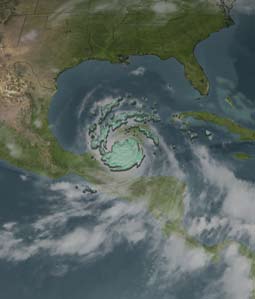
Hurricane Dean makes landfal along the Yucatan to the Local Government Units (LGUs). Each LGU now has
Peninsula on August 21, 2007. Source: NASA.
responsibility for its own resources. In 1998 the creation of the
Fishery Code further strengthened the power of the LGUs over its "municipal waters", designated to be waters
up to 15km from its coast. Included in the mandate is for each LGU to designate as fish sanctuaries at least
15% where applicable of the total coastal areas in each municipality based on best available scientific data.
Aside from typical coastal habitat mapping there are three areas which the RSWG is hoping to address: (i) rapid
assessment of the state of reefs specifically after catastrophic events eg bleaching, oil spills etc; (ii) historical
16


2008 Annual Report
and prospective assessment of vulnerability of reefs to climate change in order to feed into MPA planning; and
(iii) assessment of the capacity of reefs to recover from catastrophic events.
1
"The creation of decision-support and analysis software
for monitoring the health of coral reefs using remote sensing
is wel underway."
Available Tools:
Habitat maps: The Working Group has also progressed in its aim to demonstrate the use of acoustic remote
sensing to map fish density in Belize from a managers perspective. The project is currently producing a series of
habitat maps of Glovers Reef to identify areas of higher substrate complexity that are important as fish habitats.
Maps have been created with (i) only optical data; (ii) only acoustic data; (iii) a 3-band image comprising a depth
invariant bank and 2 acoustic layers and; (iv) a 4-band image comprising these acoustic layers combined with 2
optic bands.
Creation of an Ocean Atlas and tools to manage coral bleaching: Regional Virtual Station webpages for
sites around each Centre of Excellence (Australia, Southeast Asia and the Indian Ocean). There are now 109
Virtual Stations available on the NOAA Coral Reef Watch website at http://coralreefwatch.noaa.gov/satellite/
current/experimental_products.html. The development of an experimental data product combining satellite
measurements of light and temperature to predict coral bleaching is nearly completion with NOAA's new GOES-
satellite light product undergoing final approval prior to release as an operational product. Once the product is
operational it will be freely available on the NOAA website.
Coral reef mapping from field and satellite image data Fiji and Cook Islands: In collaboration with SOPAC,
Working Group members have been involved in the development of building coral reef habitat mapping capacity
for their scientific staff, as well as local government resource management staff from the Cook Islands. The project
was successful in delivering a benthic habitat map of Aitutaki reef in the Cook Islands, a process description to
create the map, and a spectral library of main benthic features.
17

Coral Restoration and Remediation
Working Group Members:
Dr Alasdair Edwards, Chair School of Biology, University of Newcastle, UK
Emeritus Prof Ed Gomez, Co-Chair Marine Science Institute, University of the Philippines, Philippines
Dr Richard Dodge National Coral Reef Institute, Nova Southeastern University, USA
Dr Aileen Morse Marine Biotechnology Center, Marine Science Institute, University of California-Santa Barbara, USA
Dr Buki Rinkevich National Institute of Oceanography, Haifa, Israel
Dr Makoto Omori Akajima Marine Science Laboratory, Japan
Dr Tadashi Kimura Japan Wildlife Research Center, Japan
Dr Andrew Heyward Australian Institute of Marine Science, Australia
Dr James Guest Bolinao Research Station, Philippines
The world-wide degradation of coral reefs, particularly in the past two decades, has prompted greater attention to
restoration and remediation activities. During the past four years the Restoration and Remediation Working Group
(RRWG) has been focusing upon:
1. Integrated long-term monitoring of natural recovery processes and selected interventions on standardised
substrata (Standardised Modules SMs) to evaluate efficacy and cost-effectiveness and elucidate key processes
driving/hindering recovery Interventions may include transplantation, enhancing algal grazing, augmenting
coral larval supply, and enhancing other invertebrate (and hence coral) settlement.
2. Enhancing coral larval recruitment - mass culture in open sea from egg to colony, using attractants, or by
augmenting larval supply to the reef.
3. Enhancing recovery by culture and transplantation of corals using transplants direct from reef or nursery reared
branches, nubbins, and spat.
Results for the Working Group are beginning to be obtained and in the important project exploring long-term
(5-10 years) monitoring to evaluate the efficacy and cost-effectiveness of restoration techniques, the Working
Group has been steadily collecting data from sites in Bolinao (Philippines), Palau and Mexico. Analysis at the
Bolinao site of the settlement tiles collected six-weeks after the mass-spawning and enhancement showed a
5.5-fold enhancement of larval settlement on tiles on treated Standardised Modules (SMs) compared to those on
untreated SMs. Whereas transplants on the Mexico SMs have had a 98% survival overall, following the bleaching
event and predation by COTs and corallivorous snails, less than 20% of transplants have survived at Bolinao. An
adaptive management intervention to replace the dead corals in 50% of transplant treatments with hardy nursery
reared species is being carried out in between typhoons.
The aim for `Enhancement of coral larval recruitment` projects, has been to understand constraints on site-
specific coral recruitment rates and the influence of larval supply on subsequent reproductive success, and to
investigate whether controlled settlement and metamorphosis of coral larvae onto "larval flypapers" can be used
as a successful tool for reef restoration; and to develop simple cost-effective artificial substrates for deployment
both in a land-based hatchery and for attachment to reef substrate and/or SMs. The results on competency and
stock recruitment will directly support development of better connectivity models and decision support models
associated with larval supply issues. Since March 2008 progress has been made with the experiments using
sexually reared corals for restoration. Following the March 2008 spawning, attempts were made to carry out large
scale larval rearing in Bolinao using Acropora corals. Colonies of two of the three collected species spawned and
around 200,000 larvae were successful reared to competency. These were settled onto around 2000-conditioned
coral plug-ins. Settlement was observed but average spat numbers per plug-in were relatively low after one month
suggesting that settlement was relatively low or that post-settlement mortality was high.
Under the complementary project `Enhancement of coral recruitment and restoration using "larval flypapers"',
the aim is to investigate whether controlled settlement and metamorphosis of coral larvae onto "larval flypapers"
can be used as a successful tool for reef restoration; and to develop simple cost-effective artificial substrates for
deployment both in a land-based hatchery and for attachment to reef substrate and/or SMs. During fieldwork in
September 2007, it was decided to test the feasibility of raising coral fragments both in the previously constructed
hatchery tank and attached directly to reef substrate (this was in the absence of sexual recruits). By January 2008 all
fragments and the hatchery tank were overgrown by algae so the results of the experiment could not be interpreted.
18
2008 Annual Report
However, Acropora digitifera fragments col ected
and out-planted back to the three sites from which
1
they came survived very wel ; also visual inspection
of individuals strongly suggest that fragments were
not only surviving but also growing. The objective of
this experiment was to test the differential rates of
survivorship and growth in length and biomass over
time in fragments (in same modules as above) placed
at the three different reef sites in Palau and to test the
difference in branch extension of these transplanted
fragments versus local colony branch extensions.
Results from the monitoring (April 2008) of this field
experiment indicate that after six months 100% of the
25 fragments deployed on Luke's Reef had survived;
that 83% of the 30 fragments deployed on Lighthouse
Reef had survived; and that 50% of the 28 fragments
deployed on Uchul Reef had survived. From these
early results it seems that there may be site-specific
factors such as prevailing physical (relative wave action
and/or depth) properties of individual locations that
influence differential survival.
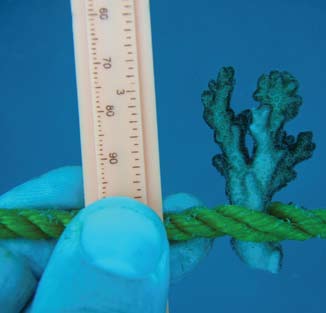
Coral reef gardening - measuring progress. Photo: Gidi Levi
The Working Group is also continuing its research into the cost-effectiveness of mass culture of juvenile corals on
substrates with juveniles of grazing snail, Trochus niloticus in mid-water nurseries, and efficacy of transplantation
to the reef after one year. The project aims to develop mass culture techniques for Acropora corals from egg
to colony in open water in Palau where there was mass bleaching damage in 1998. Growth and survival rates of
juvenile corals in co-culture with grazing snails in mid-water nurseries are being studied, and the research team
is also evaluating the effect of transplanting the juveniles on the reef after one year of rearing. The surveys in
March/April 2008 indicated disappointing results of the mass culture experiments in Palau for the last two years.
Because of heavy sedimentation and occurrence of
encrusting sessile organisms such as Ascidiacea on
the tiles in 2006-07 and of outbreak of coral disease
in 2007-08, survival rates of one year old coral colonies
in mid-water cages in both years were much lower
than expectations. In addition, nearly all one year
old colonies on 191 tiles (850 colonies in total), that
were transplanted on March 2007 to Pal et Bal s
at Lukes reef, were decimated probably by fish
grazing within three months after transplantation.
Results are indicating that there are still a number
of hurdles that need to be sorted out before the
technology can be applied widely.
The project `Enhancing recovery of transplantation
of corals' has been focusing on Montipora digitata
transplants. The experiments were essentially
completed in the middle of 2007 except for the final
fish visual census, which was conducted last February
2008. Monitoring of biological and environmental
parameters of the other single species experiments,
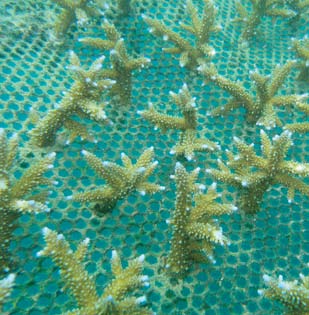
which include Porites cylindrica and Pavona danai Coral reef gardening floating nursery. Photo: Gidi Levi
transplants, was completed on October 2007 and
March 2008, respectively. The set up for the mixed species experiment of Porites cylindrica and Hydnophora
rigida was completed last February 2008 at Malilnep. The objective of the experiment is to compare the survival
and growth of the two species in single species transplant plots with those of the mixed species transplant plots.
During the May 2008 monitoring, 65% of the Hydnophora rigida transplants (70% in the single and 60% in the mixed
species plots) were found dead which resulted from predation by Drupella spp. and Acanthaster planci. H. rigida
transplants in two single species plots and in one mixed species plots were wiped out completely. This led to the
decision to replace the H. rigida transplants with P. frondifera on the same month. As a result, the mixed species
experiment of P. cylindrica and P. frondifera experiment is now at the Binlab and at the Malilnep sites.
19
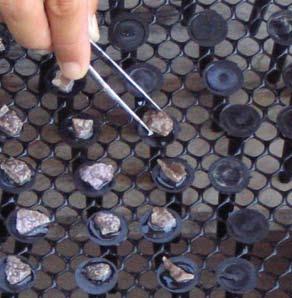
Single species plots of P. frondifera were also set-up at the source site in Victory as a control treatment. The
experiment is comparing the survival and growth of P. frondifera natural colonies and fragments transplanted at
the source site in Victory and at the transplantation sites in Binlab and Malilnep. After six months, the survival of
P. cylindrica fragments at Bolinao remained above 99% for both single and mixed species plots while the survival
of P. frondifera fragments transplanted on single and mixed species plots was 95% and 90%, respectively. On the
other hand, the survival of P. frondifera fragments at Malilnep was as low as 17% after three months in the single
species plots, wherein one of the three plots experienced 100% mortality. The P. frondifera fragments on the mixed
species plots, on the other hand, had a survival rate of 66% in contrast to the survival of P. cylindrica fragments that
remained above 99% for both single and mixed species plots. This may be an indication of an advantage of having
mixed species of transplants, when considering the P. frondifera, which may be more susceptible to predation than
P. cylindrica. In the Control treatments, the survival of the P. frondifera transplants and natural colonies at Victory
remained 100% after five months.
The final project under the Working Group, `Enhancing recovery by in situ culturing of corals in nurseries' is also
making progress. During the period March 2008-September 2008 the work has been continued on the major
aim, reef restoration through the application of the `gardening concept'; the in situ culturing of corals in nurseries
and their transplantation. Work was performed in two of the CoE areas (Bolinao, the Philippines and Zanzibar/
Mafia Island, Tanzania). This research applies cutting-edge approaches for the in situ farming and culturing of
coral material (large and healthy coral colonies amenable for transplantation into degraded reef areas) for reef
restoration. The research team continued to maintain the nurseries in Silaqui Island (the Philippines) that suffered
from several natural catastrophes last year, and the two rope nurseries. All nurseries that were established in last
reporting period have been filled with coral fragments and were maintained and monitored on a monthly basis.
The rope nursery in Malilnep is very successful until a
recent storm hit the nursery, causing mass mortality.
Two other floating nurseries that were established in
Tanzania (see half-year report) were fil ed with several
thousands of coral fragments that have grown well.
Those colonies that have already reached sufficient
size for transplantation have now been transferred
to denuded reefs. In Bolinao, the 1290 colonies
transplanted in the third year of the research onto
degraded bommies in shallow water (using a new
methodology of transplantation onto metal mesh)
have been monitored monthly. Al transplants suffered
from last year's mass-bleaching event and subsequent
coverage by fouling organisms. Monitoring activities
were concentrated on survival, rate of bleaching,
attachment of corals to the substrate, etc., and the
evaluation of transplantation protocols. During
this reporting period, as in former periods, limited
manpower was available for proper nurseries
maintenance, and as a result many of the farmed
fragments suffered and died.
Coral reef gardening preparation for rearing. Photo: Gidi Levi
20
2008 Annual Report
Students
1
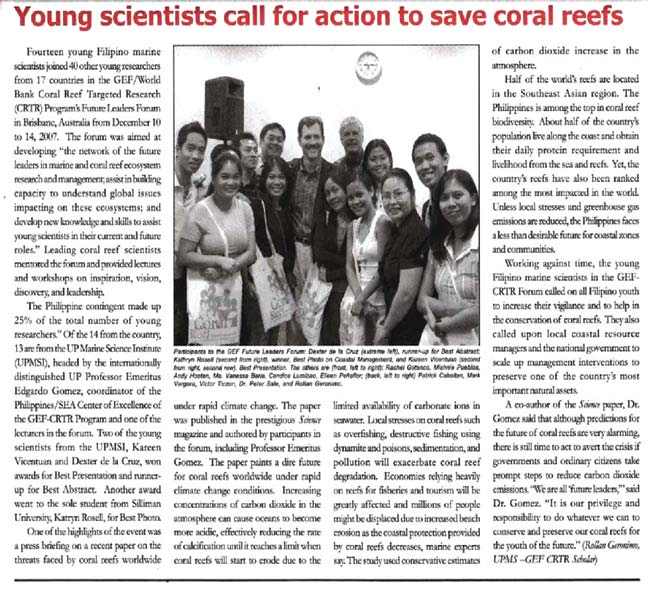
Following the Future Leaders Forum in December 2007, which was designed to get the CRTR student network
going, the student network has established itself as one of the leading `lights' of the Program. The students have
maintained their linkages through a web-based forum and through other exchange opportunities. This year the
students arranged a meeting at the International Coral Reef Symposium in Fort Lauderdale for those who would
be attending, to discuss ways in which the network can continue to link together and the possibility of some joint
papers and/or products. From the meeting, a Communication Committee was established with the responsibilities
of ensuring information is up-to-date and maintained for the network on the website. Ideas were also put forward
for potential joint publications and reports detailing success stories from around the world. The student network
is continuing to grow with students external to the Program now becoming involved and part of the network.
"The network of students sponsored by the CRTR now extends
to more than 60 students from 17 countries."
Article by Rol an Geronimo which appeared in the U.P. newsletter, January 2008.
21

CRTR Students
The table outlines the students linked to the CRTR Program either through funding support or through research
attached to the scientific Working Groups and Centres of Excellence.
Albert. Simon,
Australia
The University
Scientific tools for community-based
PhD
of Queensland
management in the Solomon Islands
Andrew. Jay,
Palau
PICRC
Training in techniques of coral culture
using sexual propagation
Arboleda. Mark
Philippines Marine Science Institute,
Prokaryotic communities associated
Dondi, Masters
University of the
with healthy and diseased corals
Philippines
Arnold. Suzanne,
USA
University of Maine
Coral settlement and recruitment
PhD
Baria. Maria Vanessa, Philippines UPMSI,
Spatial and temporal patterns of coral
Masters
Philippines
recruitment in Bolinao, Pangasinan
Bejarano. Sonia,
UK
University
Use of acoustic remote sensing to predict
PhD
of Exeter
relative fish density and grazing intensity
Boch. Charles,
USA
University of California
Understanding coral mass spawning
PhD
Santa Barbara
and the mechanisms for regulating
and controlling reproduction
Bollozos. Iris,
Philippines Bolinao Marine
Reef restoration
Masters
Laboratory
Bozec. Yves,
France
CINVESTAV,
Analysis of reef dynamics
Postdoc
Mérida
Cabaitan. Patrick,
Philippines University of
Reef restoration
Masters
the Philippines
Canto. Robert,
Australia
The University
Benthic algal growth controls in coral reefs
PhD
of Queensland
Cleland. Deborah,
Australia
Australian National
Use of ABM for social objectives
BSc (hons)
University
in a coral reef fishery
Colombo. Ma.
Mexico
Instituto de Ciencias del
The effects of elevated temperature and
Florencia, PhD
Mar y Limnologia, UNAM
pCO2 in the calcification mechanisms of
hermatypic corals
Coronado. Cesar,
Mexico
Centro de Investigación
Water circulation in the Puerto
PhD
Científica y de Educación
Morelos Reef Lagoon
Superior de Ensenada
Couch. Courtney,
USA
Cornell University
Cellular immune response of the sea
Masters
fan Gorgonia ventalina to disease and
environmental stress
Croquer. Aldo,
Venezuela
University of Puerto Rico
Geographic assessment and monitoring
Postdoc
of diseases in the wider Caribbean
De La Cruz. Dexter,
Philippines University of
Coral nurseries as an intermediate
Masters
the Philippines
step in coral restoration in Bolinao,
Pangasinan, Philippines
Diaz-Almeyda. Erika,
Mexico
Instituto de Ciencias del
The role of Desaturases on the thermal
Masters
Mar y Limnologia, UNAM
sensitivity of Symbiodinium
Fisher. Paul,
UK
Instituto de Ciencias del
Coral response to temperature and light:
Postdoc
Mar y Limnologia, UNAM
perspectives for bleaching
Fogarty. Laurel,
Ireland
University College, London
Spatial extension of fundamental models
Fung. Tak,
UK
University College, London
Modelling coral reef ecosystems and their
PhD
interaction with human societies
22


2008 Annual Report
CRTR Students cont.
1
Furaha Karisa. Juliet, Kenya
Moj University
The influence of area protection and
Masters
site characteristics on recruitment,
survival, and growth of coral species
on the Kenyan coast
Geronimo. Rollan C.,
Philippines University of
Modeling marine protected area
Masters
the Philippines
networks along the South China Sea
Gonzalez. Luis,
Mexico
Instituto de Ciencias del
Photoacclimation and thermal tolerance
Honors
Mar y Limnologia, UNAM
of Symbiodinium D1
Hogan. J Derek,
Canada
University of Windsor
Scales of larval dispersal and connectivity
PhD
among reef fish populations
Hook. Scott,
Australia
The University
The role of institutions in economic
PhD
of Queensland
development: An empirical analysis of
growth and development of small island
states in the Pacific - A case study of the
Fijian state in policy development and
implementation
Idip. David, Masters
Palau
Palau International
Remote sensing techniques for coastal
Coral Reef Center
environments and biological cycles of
coral species in Palau
Jones Chauka.
Tanzania
Institute of Marine
Molecular and physiological study of
Leonard, Masters
Sciences, University
Symbiodinium harboured by reef building
of Dar es Salaam
corals of Tanzania
Jordán Garza.
Mexico
Instituto de Ciencias
Geographic assessment and monitoring
Guillermo, Masters
del Mar y Limnología
of diseases on Mexico reefs
Kilfoyle. Kirk,
USA
Nova Southeastern
Establishing a standardised module
PhD
University
intervention and monitoring program
in Puerto Morelos, Mexico
Kongjandtre.
Thailand
The University
Taxonomy and connectivity of corals
Narinratana (Nong),
of Queensland
from the genus Favia in Thailand and
PhD
on the southern Great Barrier Reef
Leiper. Ian,
Australia
The University
Mapping tropical marine communities
PhD
of Queensland
for direct application purposes using
remote sensing techniques
León Zubillaga.
Venezuela
Universidad Simón
Genetics and connectivity
Ainhoa, Masters
Bolivar, Caracas
of Acropora palmata
Levy. Gideon (Gidi),
Israel
Haifa University
Coral reef restoration
PhD
Lim. Alan,
Canada
University of Waterloo
Use of remote sensing to detect
PhD
ecological changes in coral reef
environments using textural measures
Lumibao. Candice,
Philippines University of
Genetic analysis of juvenile rabbitfish
Masters
the Philippines
(Siganus spp) along the northwestern
coast of the Philippines
Marcos Ma. Sheila
Philippines National Institute of
Signal processing, applied physics
Angeli, PhD
Physics, University
of the Philippines
Mbije. Nsajigwa,
Tanzania
Institute of Marine
Gardening concept as an applicable
PhD
Sciences, University
tool in reef restoration in Tanzania
of Dar es Salaam
Melbourne-Thomas.
Australia
University of Tasmania
Decision support systems for managing
Jessica, PhD
coral reefs at a regional scale
Mohammed.
Tanzania
Institute of Marine
Distribution and dynamics of coral diseases
Mohammed
Sciences, University
and its relationship to coral health and local
Suleiman, PhD
of Dar es Salaam
environmental factors in Tanzania
Mojica. Angela,
Guatemala Old Dominion University
Effects of herbivorous spiny crab
Masters
(Mithrax spinosissimus) on coral
reef community structure
23

CRTR Students cont.
Ortiz. Juan Carlos,
Venezuela
The University
Ecological dynamics of coral reefs
PhD
of Queensland
in response to subtle disturbances
Padilla-Gamino.
Mexico
University of Hawaii
Coral ecophysiology and reproduction
Jackie, PhD
Penaflor. Eileen,
Philippines
University of the
Remote sensing of coral bleaching
PhD
Philippines
Porto Morales.
Colombia
Universidad de los
Coral genetics and connectivity
Isabel, Masters
Andes, Colombia
Pueblos. Miahnie
Philippines
University of the
Coral-associated microbial communities
Joy, Masters
Philippines
during recovery from PUWS disease
Rangel Avalos.
Mexico
Instituto Tecnologico
Coral reef restoration
Marcos Alberto,
de Boca del Rio,
Masters
Mexico
Ravago-Gotangco.
Philippines
University of the
Genetic connectivity of Philippine
Rachel, PhD
Philippines
populations of Siganus fuscescens
at multiple spatio-temporal scales
Ridep-Morris. Alma,
Palau
James Cook University The dynamics and epidemiology of a
Masters
coral disease outbreak in Nikko Bay
Rodrigues. Maria
Mozambique
James Cook University
Impacts of over-fishing on coral reefs
Joao, PhD
Roelfsema. Chris,
Australia
The University
Integrating field and remotely sensed
PhD
of Queensland
data: low cost, community-based
assessment of tropical marine ecosystem
health in developing nations
Rosell. Kathryn B.,
Philippines
Silliman University
The effects of the riverine discharges
Masters
on coral disease prevalence
Saenz Agudelo.
Colombia
Ecole Pratique des
Study of coral reef fish connectivity
Pablo, PhD
Hautes Etudes,
using a genetic approach
Paris, France
Salas de la Fuente.
Costa Rica
Universidad de Coasta Population genetics of the Bicolor
Eva, Masters
Rica
damselfish, Stegastes partitus
Schuttenberg. Heidi,
USA
James Cook University
Understanding effective coral reef
PhD
governance
Sweet. Mike,
UK
University of Newcastle Microbial ecology of coral surfaces
PhD
Ticzon. Victor,
Philippines
University of
Use of remote sensing to predict the
PhD
the Philippines
density of keystone taxa
Van Dien. Tran,
Vietnam
Develop tools for mapping and
PhD
monitoring reef composition and
condition in the turbid and clear coastal
waters of Vietnam
Vergara. Mark
Philippines
University of
Coral community structure of the Bolinao
Windell, Masters
the Philippines
reef system, NW Philippines
Vicentuan. Kareen,
Philippines
University of
The reproductive biology of scleractinian
Masters
the Philippines
corals and in addition, the effects of
fragmentation on their reproductive status
Villanueva. Ronald,
Philippines
University of
Long-term cost effectiveness and efficacy
Postdoc
the Philippines
of restoration interventions and factors
influencing natural recovery processes at
Bolinao and Palau
Villegas Sanchez.
Mexico
CINVESTAV - Merida
Recruitment and genetic connectivity
Carmen, PhD
of coral reef fishes from the Mexican
Caribbean
24
2008 Annual Report
2
165 The number of media outlets (in 18 countries)
which published or broadcast stories covering the
launch of the CRTR Program's first `synthesised'
research output.
Promoting Scientific Learning
and Capacity Building
2Component25
Promoting Scientific
Learning and Capacity Building
Component Two of the Program is aimed at capacity building outcomes through the promotion of scientific
learning and linking scientific knowledge to management and policy. Sound management and policy tools will
shape and change the way policy and decision-makers view and approach coral reef management. The Program
is achieving this aim through:
· Building or enhancing the capacity of institutions across four regions to serves as regional Centres of
Excellence and;
· Developing from the research, information, products and networks that can lead to better management and
strengthened policies regarding coral reefs in the regions.
The four Centres of Excellence are based in major coral reef regions (three are in developing countries) around the
world, and are hosted by leading research institutions in those regions:
· Southeast Asia: Marine Science Institute/Bolinao Marine Laboratory, University of the Philippines.
· East Africa: Institute of Marine Sciences, University of Dar es Salaam, Tanzania.
· Western Caribbean/Mesoamerica: Unidad Academia Puerto Morelos, Instituto de Ciencias del Mar y
Limnologia, Universidad Nacional Autonoma de Mexico (UNAM).
· Australasia/South Pacific: Centre for Marine Science/Heron Island Research Station, The University of
Queensland, Australia.
The Centres of Excel ence are designed to be a regional resource. As such, they have a unique responsibility to
engage stakeholders in the region and to serve as a hub for research, capacity building, information outreach
and uptake by target users. This will be a long-term effort, but steps need to be taken at the outset to begin this
process. The overarching objectives of the Centres of Excellence in Phase One are to:
· Engage regional institutions (either through training or joint research activities, or both);
· Disseminate information (in partnership with others);
· Link this to management and key decision-making opportunities (at the local, national and regional levels)
affecting coral reef management;
· Feed into other relevant programs in the region (e.g. GEF, World Bank or otherwise);
· Set up a reference or stakeholder group with which the Centre of Excellence may engage to communicate
information about the CRTR Program, receive input on how to make it relevant to capacity building and
knowledge needs in the region, and add value to ongoing projects and programs.
North
North
Paci c
Ocean
MESOAMERICA
Atlantic
Ocean
PHILIPPINES
EAST AFRICA
Indian
South
Ocean
Paci c
South
Ocean
Atlantic
SOUTHERN
Ocean
GREAT BARRIER
REEF
Centres of Excellence
26
2008 Annual Report
Australasian Centre of Excellence
Centre for Marine Studies and Heron Island Research Station, The University of Queensland
Following the fire at Heron Island Research Station in March 2007, the Station has now been rebuilt and will officially
re-open in early 2009. Improvements include new student accommodation, research laboratories, teaching labs and
seminar rooms, along with a flow-through aquaria, library and ancillaries. Despite the damage sustained from the fire,
it has had minimal impact upon the activities of the Centre of Excellence. In 2008 the CoE's research focus remained
through activities with the Bleaching Working Group, however some discreet projects were also undertaken.
The Centre of Excellence has become a partner in the Integrated Marine Observing System (IMOS), which is being
managed by the Australian Institute of Marine Science (AIMS). IMOS is designed to improve Australia's ability to
monitor changes in its 16 million km2 ocean territory, and includes the establishment of a wireless sensing network at
Heron and One Tree Islands as part of its monitoring network. As the marine data and information gathered through
the network are critical components to its success, the information will be stored in an eMII facility, providing a single
integrative framework for data and information management for use by scientists, managers and the public.
Further to the partnerships developed with the Bleaching
2
Working Group and the Australian network, the CoE has
also undertaken project partnerships with partners in the
region. Dr Ken Anthony is heading up a Packard-funded
project, which is developing an information tool package
to assist managers assess how coral reef communities will
change in response to environmental stress. Over the past
year Dr Anthony has made progress in the development of
a community dynamics model that enables formal analysis
of how changes in environmental pressures lead to shifts
in the position of community equilibria. The framework
includes basic concepts relating to overfishing, and
incorporates effects from coral bleaching, sedimentation,
nutrient enrichment and physical disturbance regimes. A
key result of the analyses demonstrates that shifts from
coral to algal abundance on reefs are driven as strongly
by stress responses to increasing thermal regime and
poor water quality as they are by overfishing. Three sets
of tool packages are currently being developed targeting
policy officials, marine park managers and reefs users.
In addition, a package is also being developed for the
curriculum of primary school users in Karimunjawa and
Semarang.
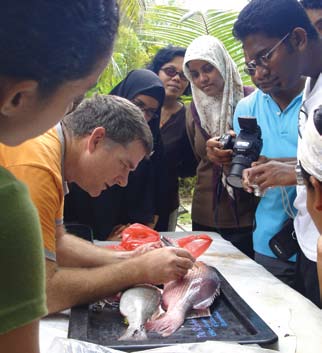
Fish ecology training, Maldives. Photo: Melanie King
Further work in the region includes the Centre of Excellence's Local Government Initiative (LGI) in the Solomon Islands,
involving a collaboratory partnership with the European Union-funded `Sustainable Forest and Conservation Project'
and Aberystwyth University in the UK. The project is working with the Kahua local community and Kahua Association
Council in the eastern Makira-Ulawa Province to develop an understanding of how to build adaptive capacity to lead
to stronger marine management of their coastline. In October the project team undertook field visits to work with the
Council to determine: economic drivers related to coastal resource use; levels of fishing effort and associated factors;
the state of the coastal environment and future changes; and community perceptions of the environment. The project
will now determine appropriate interventions for reducing local environmental impacts.
In addition to this project work, the Centre of Excellence continues to develop relationships and networks with
regional partners and provide training and information exchange opportunities. During 2008 the CoE hosted two
study tours one from the Maldives and one from the Cook Islands, as well as supporting Pacific Island participants
from Fiji, Papua New Guinea, and the Solomon Islands to attend the annual Coastal Resource Management course.
The Maldivian study tour involved senior managers from the Ministry of Environment, Energy and Water and focused
on the practical application of marine protected areas, management of tourism operations in sensitive environments,
and the latest research in coral reefs and climate change impacts. The tour was part of a larger project looking at
building capacity in ecosystem-based management. The Cook Islands contingent of government and community
members was a collaboration with the Cook Islands Marine Resources Institutional Strengthening (CIMRIS) Project
and was aimed at learning opportunities for considerations into potential partnership models between community,
business and government in which to implement ecosystem-based management projects.
27
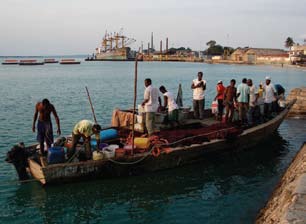
East African Centre of Excellence
Institute of Marine Studies, University of Dar es Salaam, Zanzibar
The East African Centre of Excellence continued to serve as a regional hub in the East African region for research and
training workshops. The CoE has hosted numerous international and regional researchers and students throughout
2008, and continues to expand on its institutional capacity to host the CRTR activities, amongst others.
During 2008 the Centre of Excellence has been involved in a number of collaboratory activities at the national
level, including technical and financial assistance to the Marine Parks and Reserve Unit (Fisheries Division) for coral
reef assessments in the Dar es Salaam Marine Reserves. The CoE is also collaborating with Tanga Coastal Zone
Resource Centre in the assessment of coral reefs using community-based coral reef monitoring techniques.
The local research project `Mapping and Characterisation of Coral Reefs and Associated Threats' is continuing
with the entry of coral reef threat data into the GIS database. Ranking of reef sites according to vulnerability level
and quantification of threats started with the analysis of the data from the fisherfolks, which constitute the bulk of
the data. The data indicates that dynamite fishing and fishing with drag-nets are by far the leading fishery related
threats. Analysis of other data from the field surveys with other stakeholders will permit the research team to make
the final ranking of sites according to vulnerability level and quantification of threats after taking into consideration
of the non-fishery related threats such as land-based threats, shipping related threats, population dynamics etc.
Mapping of the coral reefs and the associated habitats commenced with the analysis of IKONOS imagery in 2005
with a special focus on the reef habitats surrounding Chumbe Island (located on the northern parts of the Menai
Bay Conservation Area). To-date algorithms for mapping coral reef habitats have been developed and tested at
Chumbe reefs and supplementary field ground surveys have been conducted at other reef sites around Unguja
Island. The results obtained from the IKONOS imagery have demonstrated that this is the best approach for
future mapping of the reefs along the coast of Tanzania.
The results of the `Indigenous Knowledge on Coral Reefs Management in Tanzania' project which looked
at income trends from fishing have been mixed. Approximately 46.5% of respondents stated that there was a
decreasing trend of income from fishing due to: destruction of habitats; population increase in coastal areas and
unemployment causing people to turn to fishing activities; unsustainable upland activities such as deforestation
increasing sedimentation and runoff; and use of traditional fishing gear and vessels not allowing artisanal fishers
to go to the open sea for fishing. However, 45.8% of respondents claimed that there was an increasing trend of
income from fishing due to: use of dynamite enabling higher catches near shore; use of modern fishing gear and
vessels; high demand for fish in cities and large towns due
to population increases and increases in the price of fish
as a result of tourism; and the presence of cold storage
facilities enabling better col ection and storage. Despite
the increasing income trend from fishing activities, fishers
claimed that the money obtained was not enough to
fulfil daily basic requirements due to the increase in living
standards.
The CoE is continuing to work with local agencies
and NGOs in providing technical expertise and
information on coral reef habitats. Dr Muhando was
involved in the assessment of biophysical environment
and resources in the Dar es Salaam Marine Reserves.
In another collaboration, the CoE through Dr
Fishermen, Zanzibar. Photo: Melanie King
Muhando has been working with WWF Tanzania to
update maps of the Tanzania Coastal habitats and resources, which will be useful sources of information
for researchers and managers. In addition to these and other activities, the Centre has also been involved
in coastal zone management issues along the Tanga coast. Researchers were involved in ecological surveys
and mapping of habitats in collaboration with community members, ACEP-South Africa, Marine Parks and
Reserve Unit, Fisheries Research Institute, Faculty of Aquatic Sciences, Tanga Fisheries and the Institute
of Marine Sciences. CoE scientists are also working with Tanzania Fisheries Institute (Fisheries Division) and
the Faculty of Aquatic Sciences in executing the MACEMP-funded project `Fish stock assessment in trawlable
and non-trawlable areas'.
28
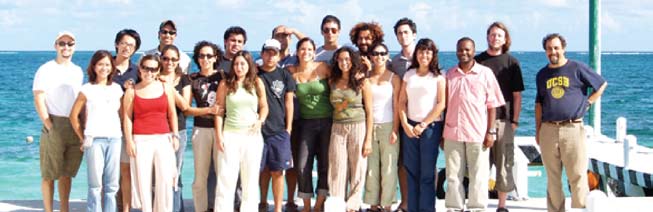
2008 Annual Report
Mesoamerican Centre of Excellence
Unidad Academica Puerto Morelos of the Instituto de Ciencias del Mar y Limnologia of the Universidad Nacional
Autonoma de Mexico (UNAM)
The CoE has also been instrumental in addressing government authorities on climate change and coral bleaching
in an effort to encourage them to take effective policies for social adaptation scenarios and policies that reduce
greenhouse gas emissions. Research activities have also continued and seen a number of collaborations being
undertaken. Collaborations with the Remote Sensing Working Group has led to a series of experiments aimed
at resolving the possible relationship between the dose of solar radiation and the rate of dose, with the loss and
recovery of photosystem II activity in coral samples under different degrees of thermal stress. The goal is to develop
a physiology-based algorithm to improve the current NOAA DHW satellite product. Further research into the
possible role of `state transitions' in different coral species was undertaken with the potential resulting information
key to understanding the effects of elevated temperatures on the early events leading to coral bleaching.
Significant progress against the two major local research priorities for the Centre of Excellence has also been
made during the year. Under the Hydrodynamic Model for the Puerto Morelos Reef Lagoon project, the team is
2
continuing to monitor the hydrological characters of the reef lagoon and the adjacent oceanic waters. To improve
critical information on the description of the mass transfer between the lagoon and the oceanic waters and allowing
for estimates to be made of the dispersal of pollutants or the transit of coral and fish larvae, changes have been
made to the distribution of the Doppler profilers along the current. The high-resolution bathymetry has also been
expanded to include 17kms of the coastline, which includes the entire Marine Protected Area. A numerical model
of the internal circulation of the coastal lagoon has also been developed. In addition to this work, the project
team has continued to analyse the energy dissipated by the reef during extreme meteorological events. The most
significant result is the realisation that the energy dissipation capacity of the reef structure is dependent on the
sea level. Modelling is now taking place on the direct effects of rises in sea level or losses in reef structure on the
coastal zone protection capacity of the reef.
Work has also continued to progress on the groundwater and nutrient load on the Puerto Morelos lagoon project.
The CoE is continuing with direct observations of the aquifer including flows, water quality and water table levels in
order to calibrate the ground water circulation model, which was generated in 2007. The data is clearly indicating
the main sources of pollutants in the area as being: (i) improper disposal of urban wastewater into the aquifer; (ii)
an open air garbage dump site located three kilometres away from the coast; (iii) the improper disposal of waste
water from the hotels.
Students participating in the Light and Photosynthesis of Coral Reefs course, Jan-Feb 2008, Puerto Morelos.
The Centre of Excellence has continued to build on its regional training courses and links to management in
building local and regional capacity. During 2008 the CoE held two training courses: Light and Photosynthesis in
Coral Reefs and Marine Protected Areas in the Caribbean Region. These two courses involved 37 students from
Mexico, Puerto Rico, Colombia, USA, UK, Tanzania, Taiwan, Cuba, and the US Virgin Islands.
The CoE has also been engaged by local and federal government authorities and local NGOs to participate in the
planning of the beach recovery program for Cancun. According to the Hotel Owners Association in Cancun and
the municipal government, as a result of the loss of usable beaches in Cancun due to extreme weather events and
poor construction practices, there is a net loss of income equivalent to USD$380 million annually. In this context,
and considering the relative importance of the income generated by the tourism industry in Mexico, developing
a sustainable beach-recovery program that minimises the damage to the local reefs whilst returning local beaches
to their `original' state is urgent.
29
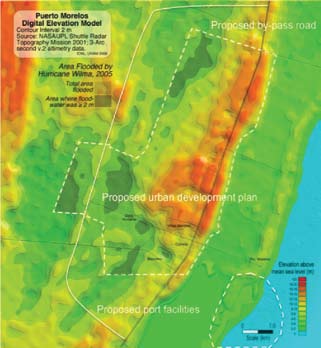
Science at Work
The local community, including local scientists and managers, were successful in employing the results of
local research projects to temporarily cancel two-large scale development projects threatening the Puerto
Morelos reefs.
I. In late 2007, a large Mexican corporation presented a project to construct a Port facility with the capacity to
handle two of the latest-generation cruise ships, all in the vicinity of the local Marine Protected Area. For the last
five years this Corporation has been lobbying local and federal governments for permission to construct port
infrastructure in the area. The latest construction plans included the removal of a "Rock" at the entranceway to
the proposed port to increase the navigational channel. The information generated by the Centre of Excellence
on the hydrodynamics of the Puerto Morelos reef lagoon, was instrumental in highlighting the dangers of such
infrastructure constructions and operations in the vicinity of a protected area. During the public consultation
process, the CoE engaged the press and the public in promoting reef conservation in Mexico.
II. In late February 2008, three weeks prior to the end of the administration, the municipal urban development agency
presented a development plan for Puerto Morelos, which included transforming Puerto Morelos to a "sleeping
town" or "dormitory city" for the workers employed by the construction and hotel industries in the Cancún
and Playa del Carmen municipalities. The proposal included construction of several large-scale low income
housing complexes for a projected increase in the local population in the next five years from approximately
12,000 to 180,000 inhabitants. Independent of the
social problems that such uncontrol ed population
growth may produce, the project ignored the
geological characteristics of the area and failed
to identify flood risk areas. In addition to this, the
proposal also neglected the construction of a water
treatment plan and ignored the possible effects on
the water quality of the beaches and on the reef itself.
The information generated by the CoE through the
groundwater project was instrumental in highlighting
the dangers of the development plan. As indicated
in Figure 1, the most obvious danger is related to
flooding in the proposed area of development due to
its location in a natural depression. This scenario was
further complicated by the proposed construction of
a by-pass road that will create an effective barrier for
rainwater. The data generated by the project indicates
the fragility of the local watershed to pol ution
generated by suboptimal or inexistent facilities for
the treatment of urban, including hotel operations,
wastewaters. Furthermore the data indicates that
this pol ution is threatening not only the drinking Figure 2. Digital elevation map showing the areas of proposed
development in Puerto Morelos. Shaded areas indicate regions
water reserves for Puerto Morelos, but also the reef. that were flooded during Hurricane Wilma on October 2005.
The information generated by the CoE was a key component to identifying the urban development plan as
unsustainable and a threat to the main source of revenue for the local population, and the reef itself. During the
consultation process, members of the CoE engaged local and national media, and the municipal governments
about the linkages of coral reef natural services and the economic development of the area. In this context,
the presentations were presented to the city councils of Cancún and Playa del Carmen on the importance of
the reefs for the tourist industry. These events received good coverage by the local media and as a result, the
CoE Chair was invited to present the CoE work as part of the World Tourism Day celebrations organised by
the municipal governments of Cozumel and Playa del Carmen in late September 2008. During this period CoE
members were also invited by the Association of Hotel owners of Cancún to present a talk on the role of the
natural services that coral reefs provide to the tourist industry.
30
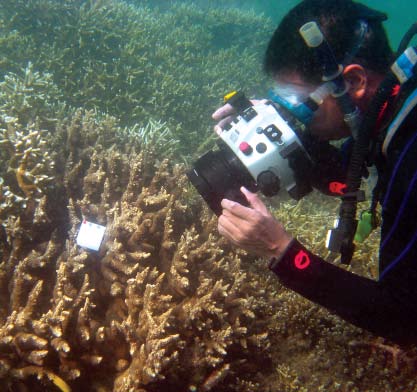
2008 Annual Report
Southeast Asian Centre of Excellence
Marine Science Institute / Bolinao Marine Laboratory, University of the Philippines
The Southeast Asian Centre of Excellence has continued to progress towards achieving its objectives through
local research projects, and a series of interactive information exchanges with a range of stakeholders. Within the
local research projects, progress on the Coral Taxonomy project is continuing with the upgrading of the reference
coral collections in the local museum and the development of local expertise for the identification of Indo-Pacific
species. Demand for the training courses is increasing with more than 40 applications being received for the
October 2008 training session. These courses are building on the earlier courses in developing the capacity of
local researchers and managers in species identification. Work on the virtual museum is also continuing with
approximately 80% of the late Prof Nemenzo type specimens now photographed, and the COENOMAP website
has been `amended' to ensure faster access and new links to the original descriptions of Philippine coral species
by Dr Francisco Nemenzo and Dr J.E.N. Veron, among others.
The `Identification and epidemiological clues of microbial coral diseases in the Lingayen Gulf' project is also
progressing well with results to-date showing that isolates of Vibrio s. confirmed as causative agents of Porites
2
Ulcerative White Syndrome (PUWS), which is the most visible infectious coral disease in the Lingayen Gulf. This
has raised questions regarding the original source of the bacteria and monitoring of the Bolinao waters since 2004
suggests that intensive mariculture activity can raise the titer of Vibrio spp as the most common copiotrophic
members of marine bacterial communities by several orders of magnitude. Repeated mesocosm experiments
designed to demonstrate the infectious impact of fish cage water containing enhanced titers of presumptive
vibrios have so far remained inconclusive.
"The program made strong in-roads into building the capacity of
scientists and managers in developing countries."
The research project on connectivity studies to support conservation and management of reef ecosystems in
Bolinao is also producing results indicating significant genetic differentiation with putative partitioning of the six
populations of S. fuscescens studied into genetically distinct groups. On the other hand, analyses using landmark-
based multivariate morphometric methods did not reveal distinct population differentiation among study sites,
suggesting that these methods might not be powerful enough differentiate S. fuscescens populations.
Progress is also continuing on the common
sampling project and on the Local Government
Initiative. Under the common sampling project,
13 study sites have now been established at
Bolinao and Batangas. Initial monitoring work has
commenced with sites marked and photographed
using standard protocols, and random transects
at Bolinao being analysed for coral cover and
composition. The project is currently acquiring
materials for the fabrication of recruitment tiles
and blocks for deployment in the two locations.
Local Government Initiative
The Local Government Initiative is also progressing
well with numerous activities being undertaken.
Fol owing last year's formulation of draft operating
procedures on coastal law enforcement, the
project participated in the `Coastal Resources
Management Forum' in August 2008. This
Forum served to foster and enhance inter-Local Dr. Wilfredo Licuanan examining a new coral species record for the
Government Unit (LGU) col aboration in western Philippines. Photo: Mark Vergara
Pangasinan through sharing of experiences and identification of common key actions. It focused on the challenges
and opportunities related to the strengthening or scaling up of coastal resources management efforts undertaken
by local government units. The three themes of the Forum were: i) sustainable mariculture development; (i ) coastal
tourism; and (iii) management of marine protected areas. Local coastal resource managers, municipal fishermen,
31

people's organisations and the tourism sector all shared initiatives and plans in a collaboratory effort. The CoE
researchers supported the Forum by providing scientific information on the value and status of coastal ecosystems
in the region, and results of pertinent research initiatives.
The project has also been providing technical assistance to the MPA establishment in Agno and MPA ordinance
to the Barangay Council of Tupa, Agno. For the MPA establishment the CoE team collected data to determine the
best site(s) for the MPA establishment in the municipality. After the completion of these underwater assessments,
the project conducted community validation workshops. The workshops were held to disseminate information,
gather and validate important information and to lobby support for the MPA establishment in the municipality.
The municipal mayor of Agno attended the workshop and encouraged his constituents to support the initiatives.
Under the MPA ordinance component, the project team provided technical assistance following a request by the
council to improve the proposed local ordinance in terms of form and substance. Additional inputs pertaining to
MPA establishment were integrated to the legal instrument being drafted by the Barangay council.
In the Bolinao area the project has been working with LGUs, MPA managers and the local coastal law enforcers
to incorporate the MPA Enforcement Protocol Guide as part of their management plan. It was conceptualized to
help improve the law enforcement activities covering the eight MPAs in the municipality and as a guide for the
enforcers to discharge their duties and functions effectively. The LGU of Bolinao is now planning to initiate the
formulation of the unified MPA management plan that would cover existing MPAs in the municipality. The plan will
facilitate the coordination of all the initiatives at the municipal level and will harmonise all the rules and regulations
pertaining to MPA management.
32
2008 Annual Report
69 The number of events training courses,
workshops, media opportunities, meetings
and conferences the Program undertook
or participated in during 2008.
3
Linking Scientific Knowledge
to Management and Policy
3Component33

Linking Scientific Knowledge
to Management and Policy
During the year there have been some significant activities including the completion of the CRTR Program's
Mid-term Review, the continuation of the ecological sampling project, Palau resilience project and the Bolinao
aquaculture project (see Disease Working Group report).
Mid-term Review
In February 2008, the Mid-term Review of the Program was contracted out to an international team of five reviewers.
The evaluation served two purposes:
I. Development Grant Facility: the goal was to enhance the impact of ongoing and future global programs and
partnerships by assessing and reporting on the outcomes achieved under the grant relative to its objectives, the
effectiveness of implementation arrangements and other processes designed to deliver results, and to provide
feedback to the major funders regarding key lessons learnt and effectiveness of the grant to inform the design
of future partnerships, and;
II. Global Environment Facility: the main purpose was to take stock of implementation this far; assess whether or
not objectives are being met and outcomes are likely to be achieved given current institutional arrangements,
funding levels and resource allocation; identify any course corrections and; agree on key benchmarks that may
serve as triggers for a second phase.
The final report has now been accepted with the main findings demonstrating that the CRTR Program is relevant
to international priorities for coral reef research, and that it has been able to increase knowledge on important
areas such as coral reef protection and bleaching, with the Centres of Excellence found to be both relevant and in
demand by local users. For the complete findings of the Review, Volume One is available for download from the
Program's website (Publications) at www.gefcoral.org.
Benthic field methods to detect change and key processes
structuring the coral communities at the Centres of Excellence
The ecological sampling, or `common sampling' project as it is more commonly known is designed to implement a
set of key monitoring techniques to assess the dynamics of coral populations and associated coral reef organisms
by defining key ecological processes that regulate the populations, across the four regional Centres of Excellence
which can be replicated across the globe. The project aims to establish and evaluate processes at localities that
may lead to comparisons across spatial scales over time. In this project, the team is interested in the processes that
influence the structure of coral communities at the various habitats in the vicinity of the Centres of Excellence.
Al sites were re-examined in the past year with fieldwork being conducted in Zanzibar, Heron Island, Mexico
and the Philippines. In the Philippines (which was established later than the other sites), all 13 sites have now
been selected and established. Initial monitoring work has commenced with sites marked, photographed using
standard protocols and random transects at Bolinao being analysed for coral cover and composition. The project is
currently acquiring materials for the fabrication of recruitment tiles and blocks for deployment in the two locations
Bolinao and Batangas.
The Project now has three years of data from the Heron Island, Zanzibar and Mexico sites on rates of change in
key state variables such as coral and macroalgal cover and size frequency distributions, and also data on vital
processes such as recruitment, post-settlement mortality, coral growth, partial mortality (and complete mortality),
and colony fission and fusion.
34
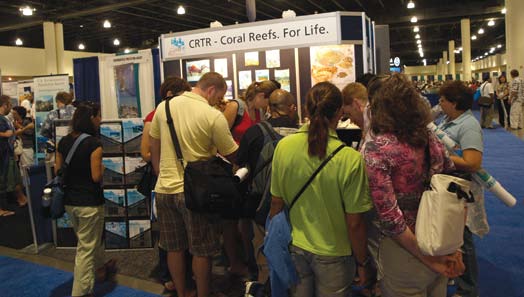
2008 Annual Report
Palau Resilience Project
The Palau Resilience project is examining the role of herbivory as a key process in its control of algal abundance
as a prime regulator of the recruitment of reef corals. In November 2007, a common garden experiment was set
up in which grazing from large parrotfish was manipulated by using parrotfish exclusion devices (PEDs) that locally
reduce herbivory in the microenvironment of settlement plates. If PEDs work in Palau as they have in Belize, the
research team will see macroalgal tufts and anticipate concomitant reductions in coral recruitment. As was done
at the sites in the Caribbean, the research team is revisiting the Palau sites (in January 2009) to examine the effects
of the PEDs on the succession of organisms and coral settlement in this subcryptic nursery habitat (the plate
undersides).
The research team are specifically manipulating herbivory by manipulating the most functionally important group
of herbivores - the large parrotfish. Thus, they will be able to get beyond just the process effect (i.e. changing
herbivory) by quantifying how it affects the recruitment potential of coral reef ecosystems. Importantly, by focusing
on a manipulation of large scarids the results simulate the effects of moderate fishing pressure (which contrasts
with the more acute - but less policy relevant - approach of using full cages to exclude all grazers). If the process
of herbivory is a key driver of coral recruitment and the resilience of coral reefs, it should be evident among
biogeographically distinct coral reef ecosystems that have no species in common. If the research can show that
herbivory from large parrotfish controls algal development sufficiently to affect coral settlement, the research
team will be able to make profound recommendations to managers of coral reefs. Specifically, these results could
provide a clear and practical rationale for prohibiting the taking or killing of large parrotfish.
3
CRTR information stand at the 2008 International Coral Reef Symposium, Fort Lauderdale. Photo: Andy Hooten
11th International Coral Reef Symposium
CRTR Program members (researchers and students) participated in the 11th International Coral Reef Symposium
at Fort Lauderdale on 7-11 July. The Program was well represented with Dr Roberto Iglesias-Prieto and Dr Drew
Harvell participating as keynote speakers during the week. Many of the senior researchers and students from the
Program participated in plenary presentations and poster presentations.
The Program was a major sponsor of the event and mounted a display of publications and tools, including the
Disease Manual and Underwater Cards, the Restoration Guidelines manual, copies of the `The Carbon Crisis'
Science Magazine paper and Research Updates for the Working Groups and Centres of Excellence.
35

36
2008 Annual Report
350 The percentage growth in the number of unique
visitors visiting the CRTR Program website.
Program Management
4 4
Component
37
Program Management
As the Project Executing Agency The University of Queensland (Brisbane, Australia) is responsible for the
management of the CRTR Program. Program management responsibilities include financial management and
reporting; strategic communication and capacity building activities; information management; stakeholder liaison;
and co-financing sources.
During Year Four, the Program has made steady progress towards meeting its approved activities and Phase One
objectives with the following outlining the status of disbursements and procurement, as well as the Program's
communication activity for the year.
Communication
During 2008 the Currie Communications team of Mr Mark Paterson, Dr Bruce Munday and Ms Gabrielle Sheehan
executed internal and external communication activities designed to inform not only the Program members, but
also the Program's audiences of coastal/coral reef managers, policy-makers and scientists with information based
on the Program's research outputs. The key outputs from the communications team for the CRTR Program during
2008 included:
· The launch of a quarterly HTML e-newsletter for members, CRTR E-News in January
· The start of communications update, Coralert! to key CRTR Program people in April
· The release of three flagship products from the Disease Working Group in July
· A showcase of tools and publications at the International Coral Reef Symposium in July
· A major re-design of the program website, www.gefcoral.org, in September/October
· The development and production of a brief film/video profile for the program in October
Communication activities for the year commenced in December 2007 with the media
launch of the CRTR Program's first `synthesised' research output, the scientific paper,
`The Carbon Crisis: Coral Reefs under Rapid Climate Change', published in the
14 December, 2007 issue of Science Magazine. The paper highlighted the urgent
action required to protect coral reefs from rising concentrations of carbon dioxide
in the Earth's atmosphere. Within 24 hours of the press conference, 165 media
outlets in 18 countries had reported the paper's main message, that, in order to
save coral reefs, there needs to be immediate action from world leaders to urgently
cut CO emissions, and from policy-makers and reef managers to stop over-fishing,
2
pollution and unsustainable coastal development. Comments from the paper's
CRTR Program authors were reported on the front pages of national newspapers,
including USA Today and The Australian, and on international newswires Associated
Press, Reuters, Bloomberg and Agence France Presse. The story featured as the
number one science article monitored online by Google (Australia) on the day of
Synthesis paper, Science
Magazine, December 2007.
the release.
Following on the heels of this event, the CRTR Program members participated in the 11th International Coral Reef
Symposium at Fort Lauderdale on 7-11 July. The Program was well represented with many of the senior researchers
and students from the Program participating in keynote addresses, plenary presentations and poster presentations.
The Program was also a major sponsor of the event and mounted a display of publications and tools, including the
Disease Manual and Underwater Cards, the Restoration Guidelines manual, copies of the `The Carbon Crisis' Science
Magazine paper and Research Updates for the Working Groups and Centres of Excellence.
Communication activities continued with the aim of promoting the Program's information to its wide membership
and in working with Working Groups and Centres of Excel ence in communicating their research outputs. In efforts to
bring the researchers, students and management closer together despite the distances and different countries, the
Communication Team commenced the year with the development and dissemination of two internal communication
tools: a quarterly e-newsletter and a regular communication email update. The quarterly e-newsletter, CRTR E-News,
is the main communications vehicle for keeping the CRTR Program `family' in-touch with news, events and progress
across the program. This newsletter was launched in January 2008 and is sent to 152 recipients every three months.
CRTR Program members contribute many of the articles and images. A second newsletter, Coralert!, is sent to 82 key
CRTR Program personnel every eight weeks, updating them on specific communications activity and outputs, as well
as seeking their ideas for products, tools and activities.
38
2008 Annual Report
Working with the Working Groups and Centres of Excellence has also
produced a series of Research Updates, documenting the progress
made by these groups during the past year, and discussions with
Working Group chairs during ICRS have led to planning for future
outputs from many of groups for 2009. During 2008, communications
meetings were also held with the Centres of Excellence in East Africa,
the Philippines and Mesoamerica. These sessions sought to identify
the priority needs of the CoEs and determine their key outputs during
the remainder of Phase One of the program. These discussions will
be completed with CoE chairs at the Synthesis Panel meeting in
Australia during November 2008. As a result of these meetings, local
communications workplans and training workshops will be presented
in each of the regions during 2009.
During 2008 the Program undertook or participated in 69 events
training courses, workshops, media opportunities, meetings and
conferences. In addition to this Program members produced 174
publications, either journal articles, book chapters, conference papers,
media articles or electronic products. These publications are classified Website November 2008.
as either fully or partially supported by the Program, or not supported but having an influence on, or being
influenced by, the research being undertaken by the Program Working Groups and Centres of Excellence.
"The communications team wil , with the support of scientists,
maintain a flow of new information based on research and
capacity building activities."
Website
The number of unique visitors to the CRTR Program website has grown 350% in the past year. In 2008 (as at end of
September), there have been 22,058 unique visitors; 31,812 visits; and 127,632 pages accessed, and; 786,724 hits.
More time has been invested in maintaining the Latest News section, starting an Image Library and establishing an
online facility to order Publications. Upon consideration of the growing traffic to the website, together with the rising
tide of scientific know-how from the Program, a decision was made to further invest in the design and usability of this
cost-effective channel. As a result, a fresher, easier-to-navigate site will be unveiled during November 2008.
6000
CRTR Website Traffic (Oct 07 - Sept 08)
5000
Unique visitors
Number of visits
4000
3000
4
2000
1000
Oct-
Nov-
Dec-
Jan-
Feb-
Mar-
Apr-
May-
Jun-
Jul-
Aug-
Sep-
07
07
07
08
08
08
08
08
08
08
08
08
39

Corporate Branding
The communications team is working on a video profile and stakeholder forum, two activities designed to raise
awareness of the CRTR Program and increase understanding about its role. The video profile will be available
to CRTR Program members and partners for use in presentations from November 2008 and will be featured on
the website. The stakeholder forum, to be staged in partnership with the Great Barrier Reef Foundation at the
University of Queensland on 3 November 2008, seeks to open dialogue between the program and Australian
business leaders with an interest in marine conservation. Both activities seek to generate awareness that the
condition of coral reefs is not simply an environmental issue, that their health is inextricably linked to the social and
economic wellbeing of those countries, where the livelihoods of 100 million people rely upon them.
2009 `Harvest Year'
The communications team is calling the year, 2009, the `harvest year' for phase one of the program. As the fifth and
final year of the program's first phase, next year represents an opportunity to harvest (collate and summarise) the
new knowledge generated by the program's investment to-date. The communications team will, with the support
of scientists, maintain a flow of new information based on research and capacity building activities, together with
targeted campaigns to raise awareness of the issues facing coral reefs, and the information available through the
CRTR Program.
40


2008 Annual Report
AAbbreviations41

Abbreviations
ACEP - African Coelacanth Ecosystem Programme
AIMS Australian Institute of Marine Science
BWG Bleaching Working Group
CIMRIS Cook Islands Marine Resources Institutional Strengthening
COENOMAP A web-accessible, map-oriented database on the distribution of corals in the Philippines
CO2 Carbon dioxide
CoE Centre of Excellence
CORDIO Coral Reef Degradation in the Indian Ocean
COT Crown of Thorns
CRTR Coral Reef Targeted Research & Capacity Building for Management Program
CWG Connectivity and Large-Scale Ecological Processes Working Group
CYBD Caribbean Yellow band Disease
DGF Development Grant Facility
DHW Degree Heating Weeks
DWG Disease Working Group
ECONAR Project Ecological Connections Among Reefs Project
ESA European Space Agency
GEF Global Environment Facility
ICRS International Coral Reef Symposium
IMOS Integrated Marine Observing Sytem
LGI Local Government Initiative
LGUs Local government units
MACEMP Marine and Coastal Environment Management Project
MBRS Mesoamerican Barrier Reef System
MERIS Medium Resolution Imaging Spectrometer
MPA Marine Protected Area
MDSWG Modelling and Decision Support Working Group
NGO Non-government Organisation
NORDECO - Nordic Agency for Development and Ecology
NOAA National Oceanic and Atmospheric Administration
PEDs Parrotfish exclusion devices
PICRC Palau International Coral Reef Center
PTD Project To Date
PUWS Porites Ulcerative White Syndrome
RRWG Restoration and Remediation Working Group
RSWG Remote Sensing Working Group
SMs Standardised Modules
SOPAC Pacific Islands Applied Geoscience Commission
TNC The Nature Conservancy
UNAM Universidad Nacional Autonoma de Mexico
UNU-INWEH United Nations University International Network on Water, Environment and Health
UPMSI University of the Philippines Marine Science Institute
UQ University of Queensland
42


2008 Annual Report
43
The Coral Reef Targeted Research & Capacity Building for Management (CRTR) Program is a leading international coral reef
research initiative that provides a coordinated approach to credible, factual and scientifically-proven knowledge for improved coral
reef management. The CRTR Program is a partnership between the Global Environment Facility, the World Bank, The University of
Queensland (Australia), the United States National Oceanic and Atmospheric Administration (NOAA) and approximately 50 research
institutes and other third-parties around the world.